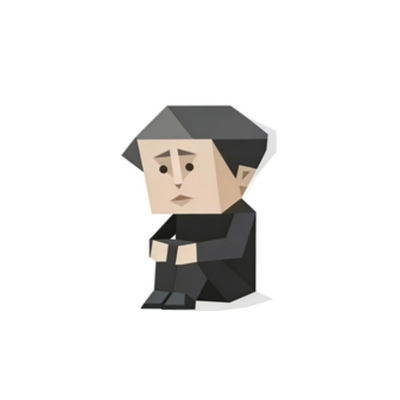
I'm crying... how am I the orphan type??
SOLO — The Lone Wolf: Complete SBTI Personality Guide
An Unsent Letter
Dear whoever finds this,
I'm not going to send this. You should know that up front. I write letters I don't send the way other people go to therapy — frequently, earnestly, and with no expectation that anything will change. This isn't a cry for help. It's more like a proof of existence. A message in a bottle thrown into an ocean I don't plan to swim in.
So. Here we are. Let me tell you about me, since you asked. (You didn't ask. Nobody asked. That's sort of the point.)
I chose this. I need you to understand that before anything else, because people always get it wrong. They see someone alone and they assume damage — that something happened, that someone left, that there's a tragic backstory involving a rainy night and a slammed door. And maybe there is. I'm not going to confirm or deny. But the solitude itself? That was a decision. A deliberate, eyes-open, fully conscious decision to step back from the crowd and stay back.
It's not that I don't like people. I do. In theory. In controlled doses. The way you might like fireworks — beautiful from a distance, overwhelming up close, and you definitely don't want one going off in your living room.
My relationship alarm system is, I'll admit, somewhat sensitive. Not hair-trigger — I'm not jumping at shadows. But I notice things. A shifted tone. A cancelled plan. A pause that lasts half a second too long. And my brain, which is a deeply unhelpful organ, immediately begins drafting worst-case scenarios with the efficiency of a Hollywood writers' room. "They're pulling away." "They've realized you're too much." "They've realized you're not enough." The paranoid inner monologue runs its course, and by the time reality catches up, I've already built a wall.
I know the walls are the problem. I built them anyway. Because walls don't cancel plans. Walls don't leave you on read. Walls are reliable.
You might wonder what I do in all this alone time. The answer is: a lot. Or nothing. The ratio varies.
I have a strong sense of order. If there's a process, I follow it. Not because I'm obedient — I'm deeply suspicious of authority and systems that exist "just because" — but because structure gives me something to lean on when the inside gets chaotic. And the inside gets chaotic more than I'd like to admit. The defensive filter through which I view the world isn't paranoia. It's pattern recognition. I've seen enough to know that most things don't work out the way people promise they will, and I'd rather be pleasantly surprised than devastated.
So I suspect first and approach later. This makes me an excellent judge of character and a terrible first date. I've made peace with the tradeoff.
Here's the part I don't tell people, which is why it's going in an unsent letter instead of a real conversation:
I'm soft. Inconveniently, embarrassingly, frustratingly soft. The person who chose solitude, who built the fortress, who keeps the interpersonal boundaries tight enough to qualify as architectural — that person cries at dog videos. That person remembers what you said three years ago about your grandmother and will bring it up at exactly the right moment. That person, if they ever let you past the drawbridge, would give you every last piece of themselves and consider it a bargain.
The emotional investment is there. It's just locked in a vault. Not because the vault protects me from you — but because the vault protects you from the weight of what I'd feel if I let it out. I've been told this is dramatic. I've been told this is also correct.
Here's what my days look like: I wake up. I exist in my space, which is arranged exactly the way I want it because no one else is here to rearrange it. I do my work, which I approach slowly — orbiting decisions, considering angles, taking my time — because rushing feels reckless and reckless feels dangerous and dangerous feels like the thing I've spent my whole life avoiding.
My motivation system is cautious. Risk-avoidance boots up before ambition does. Step one is always "how do I not crash." Step two is "okay, maybe I can move forward a little." Step three is usually just step two again, slightly faster. I'm not lazy. I'm careful. There's a canyon of difference between the two, and I live at the bottom of it.
I don't reach out first. Social initiative takes about half a day of psyching myself up, and by the time I'm ready, the moment has passed and I've convinced myself it's better this way. It probably is better this way. It probably isn't. I'll never know because I didn't send the text.
Like I won't send this letter.
But listen. If you're reading this — if somehow this bottle washed up on your shore — I want you to know something. The alone isn't empty. It's full. It's full of me, in all my overthinking, oversensitive, fortress-building, dog-video-crying absurdity. I've built a life that fits one person perfectly, and that person is me, and most of the time, that's enough.
Most of the time.
There are nights when it isn't. When the silence stops feeling like peace and starts feeling like proof. Proof that I was right to be careful, that the world is exactly as unreliable as I suspected, that the walls were the correct architectural choice. And also — simultaneously, contradictorily — proof that I might have gotten it wrong. That the thing I was protecting myself from might have been the thing I needed.
I don't know. I won't figure it out tonight. I'll go to bed, and the alone will be there in the morning, warm and familiar and mine, and I will continue to not send this letter to no one, and tomorrow will be another quiet day in a quiet life, and that will be fine.
Fine is my ceiling and my floor. It holds.
Yours (hypothetically, theoretically, never in practice),
A SOLO
Dimension Breakdown
Attachment Security (Low): The alarm system hums quietly at all times. You don't panic — you prepare. Every relationship carries an escape route mapped in advance, just in case.
Emotional Investment (Low): The vault is real. You feel everything; you show almost nothing. Enterprise-level security on who gets access to the emotional mainframe.
Boundaries & Dependency (High): Personal space is non-negotiable. You need a room of your own — literally and metaphorically. Love is welcome, but it needs to knock first.
Worldview Orientation (Low): Defensive filter engaged. You suspect first, approach later. This keeps you safe and also keeps you isolated, which is either the same thing or the opposite thing, depending on the day.
Social Initiative (Low): Your social engine is slow to start. Reaching out first takes the kind of emotional preparation usually reserved for job interviews and dental procedures.
If You're a SOLO
Here's the truth you already know but don't want to hear: the fortress works. It keeps things out. It also keeps things in. And the thing it keeps in most effectively is you.
You don't need to tear down the walls. That's a bad metaphor pushed by people who've never needed walls. But you might consider installing a door. A real door, with a handle, that opens from both sides. Not so someone can barge in — so that you can walk out. On your terms. At your pace.
Start with low-stakes connection. A regular coffee shop where the barista knows your order. A group chat you actually respond to once a week. A friend you text back within the same calendar day. These aren't compromises on your solitude — they're expansions of it. The alone can include other people, if you let it.
And send one letter. Just one. It doesn't have to be this one. It can be small. A thank-you note. A "thinking of you." Something that crosses the moat and lands on the other side.
You might be surprised who writes back.
Dimension Analysis
You come for yourself harder than anyone else could. Someone gives you a compliment and your first instinct is to check if they want something.
You generally know who you are, but emotions can hijack the controls and make you feel like a different person for a while.
Comfort and safety come first. Life doesn't need to be a nonstop grind — you'd rather not run a sprint you didn't sign up for.
Your relationship alarm system is hair-trigger sensitive. A 'seen' with no reply and you've already scripted the breakup scene in your head.
You're restrained with feelings — not heartless, just running enterprise-level security on who gets in.
Personal space is non-negotiable. No matter how deep the love, you need a room of your own.
You see the world through a defensive filter — suspect first, approach later.
You've got a strong sense of order. If there's a process, you'd rather follow it than improvise and hope for the best.
Meaning feels scarce. A lot of things feel like you're just going through the motions.
Your risk-avoidance system boots up before your ambition does. Step one is always 'how do I not crash.'
You think it through but don't blue-screen. Normal, healthy hesitation.
Your productivity has a deeply committed relationship with deadlines. The closer the deadline, the more you ascend.
Your social engine is slow to start. Reaching out first takes about half a day of psyching yourself up.
Strong boundary game. Someone gets too close and your instinct is to take half a step back.
You read the room before you speak. A little honesty, a little diplomacy — you split the difference.
Compatibility

Related Types

Are you a SOLO?
Take the SBTI personality test to find out your type.